


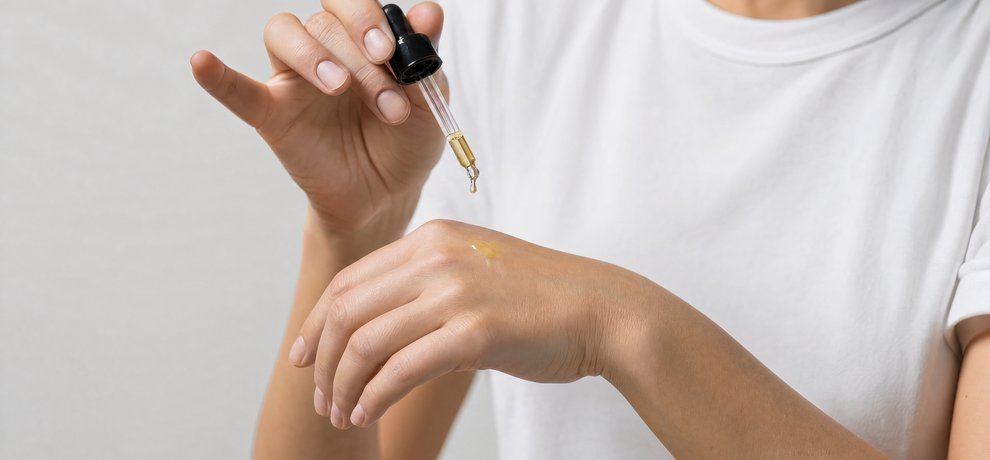
With 75 to 85% geraniol in its composition, Palmarosa Essential Oil ranks among the most versatile essential oils in aromatherapy. Its rose-like scent earned it the nickname Indian Geranium. Prized for its cleansing and purifying properties, it is traditionally used on the skin, nails and scalp. Here are its properties, its practical uses, the right doses and the situations where it is better to abstain.
Palmarosa, the Indian Geranium: origin and composition
Palmarosa (Cymbopogon martinii var. motia) is a tall tropical grass from the Poaceae family, the same one as Lemongrass. Native to India and Nepal, it is also grown in Vietnam, Madagascar and several warm regions of Asia. The plant can reach nearly 3 metres tall on the dry soils close to watercourses.
Its name comes from the smell of its leaves: a herbaceous note reminiscent of rose and geranium. It is this olfactory signature that explains the nickname Indian Geranium, even though the plant has no botanical link with geranium. In India, it has been used since the 18th century, and Ayurvedic medicine credits it with toning and skin-repairing virtues. Its rose scent once made it an inexpensive substitute for rose essence in perfumery, and it was used to flavour certain tobaccos.
The Essential Oil is obtained by steam distillation of the aerial parts of the plant. The yield remains low: it takes nearly 100 kg of fresh plant to produce between 500 g and 1.25 kg of oil. The resulting liquid is pale yellow, fluid, with that characteristic rose scent. As a reference point, 1 ml corresponds to about 35 drops, useful for measuring out your preparations.
On the biochemistry side, the profile is dominated by a monoterpene alcohol, geraniol, accompanied by its ester, geranyl acetate. It is this combination that guides most of its uses.
- Geraniol, monoterpene alcohol: 75 to 85%
- Geranyl acetate, ester: 7 to 16%
- Linalool, monoterpene alcohol: 1 to 5%
- trans-beta-ocimene, monoterpene: 0.5 to 3%
- beta-caryophyllene, sesquiterpene: 0.7 to 2.5%
- Farnesol, sesquiterpene alcohol: 0.2 to 1.5%
These proportions vary depending on the origin and the harvest. This is why mentioning the chemotype and checking the geraniol level matter as much as the name of the plant, a point we come back to further down. To compare this profile with other oils, our range of Essential Oils specifies the biochemical composition of each one.
The properties of Palmarosa Essential Oil
The high geraniol content explains most of the properties attributed to Palmarosa. This molecule is the subject of numerous studies for its action on micro-organisms, backed up by geranyl acetate, which adds a more soothing dimension.
The Essential Oil is first and foremost known as cleansing. Several in vitro studies have observed an action of geraniol on the fungi responsible for skin and nail mycoses, including their most resistant forms. This is one of the reasons Palmarosa comes up so often in aromatherapy advice related to mycoses, sometimes cited as an alternative to Tea Tree.
It is also described as broad-spectrum purifying. Geraniol acts on the bacteria involved in acne and on those responsible for perspiration odours, which paves the way for its skincare and deodorant uses. Some research also credits it with an anti-inflammatory action and a spasmolytic effect, meaning a relaxing of the smooth muscles.
Beyond this twofold cleansing action, Palmarosa is traditionally presented as:
- a skin tonic and astringent, it helps tighten pores and contributes to the comfort of oily skin
- regenerating and skin-repairing, it supports skin renewal and accompanies small imperfections
- purifying and cleansing, both in diffusion and in diluted application
- a general tonic, it is recommended during periods of temporary fatigue and low energy
- draining, it features in blends designed for the comfort of heavy legs
A useful clarification: in aromatherapy, these properties describe a traditional and wellness use. They never replace medical advice or a prescribed treatment. If a symptom persists, the right reflex remains to consult a professional.
How to use palmarosa essential oil day to day
Palmarosa is used mainly on the skin, always diluted in a vegetable oil, and in atmospheric diffusion. The oral route exists but remains reserved for guidance by a healthcare professional, because of the risk of interactions. Before any first skin use, a patch test on the crook of the elbow 24 to 48 hours in advance helps check tolerance. Geraniol is a potent active, and caution comes before quantity.
- Skin route: around 20%, that is 1 drop of essential oil per 4 drops of vegetable oil, 2 to 3 times a day in a short course.
- Skin route on a wide area or on sensitive skin: 10% or less, 2 to 3 times a day in a short course.
These reference points apply to an adult. Contraindications: pregnant women, breastfeeding women and children under 6 years old.
For mycoses and to purify the skin
This is the most documented use. For a mycosis of the skin or nails, Palmarosa is often combined with other purifying essential oils such as Tea Tree Essential Oil and True Lavender Essential Oil. A common blend combines 1 drop of each of these three oils in 5 drops of vegetable oil, to be applied 2 to 3 times a day to the affected area, on clean, dry skin. On nails, Castor vegetable oil serves as a base because it adheres well.
On blemish-prone skin, Palmarosa Essential Oil helps to cleanse and regulate sebum. It fits well into a targeted routine, in synergy with actives such as those in our skincare range. To go further on this topic, our article on acne and aromatherapy details the suitable blends and the steps to avoid.
As a deodorant and for excessive perspiration
Palmarosa helps slow the development of the bacteria responsible for bad odours, without blocking perspiration itself. This is the basis of many homemade deodorants. A simple recipe combines 15 drops of Palmarosa and 10 drops of Clary Sage in 30 ml of a neutral base or a hydrosol, to be applied in the morning to clean, dry skin.
Its floral fragrance is a real asset: it brings a pleasant note where other purifying oils tend to evoke more medicinal scents.
For oily hair and dandruff
On a scalp that gets greasy quickly, Palmarosa Essential Oil helps to regulate sebum and to cleanse. You add 1 to 2 drops to a dose of neutral shampoo in the palm of your hand, or you incorporate it into a hair blend with Atlas Cedar. Our oily hair care recipe gives a complete protocol, dilutions included.
For dandruff, Palmarosa pairs with cleansing essential oils such as Tea Tree Essential Oil over a short period so as not to irritate the scalp.
For the comfort of heavy legs and drainage
Palmarosa can be included in wellness blends focused on a feeling of lightness, in combination with other essential oils traditionally used for circulatory comfort, such as Cypress or Rose Geranium.
In skin application, it is essential to always dilute it in a suitable vegetable oil before massage. A gentle movement, working up from the ankles towards the thighs, is often favoured in leg comfort routines.
For greater simplicity, our range dedicated to circulatory comfort offers ready-to-use formulas.
To tone the body in case of fatigue
During periods of low energy, Palmarosa is recommended in diffusion or in diluted massage along the spine and on the solar plexus. Its rosy scent has a comforting side, and its general toning action makes it a good companion at the end of winter. In diffusion, about ten drops for 10 to 20 minutes is enough, never in the presence of a young child. For a more toning effect, you combine it with a citrus such as sweet Orange essence, which further softens the rose note and makes the morning diffusion more cheerful.
Precautions for use and contraindications
Palmarosa is a safe Essential Oil when a few rules are respected, but it is not harmless. Its high geraniol content makes it allergenic and potentially irritating when applied neat to the skin.
The points to remember before any use:
- Contraindicated for pregnant and breastfeeding women and children under 6 years old.
- Never neat on the skin. Always diluted in a vegetable oil, and carry out a prior patch test on the crook of the elbow.
- Hormone-dependent history: in the case of a hormone-sensitive background, the advice of a healthcare professional is necessary before any use.
- Medication, asthma, epilepsy: ask a doctor or pharmacist for advice before starting.
- Oral route: reserved for guidance by a therapist, because of the possible interactions.
Avoid contact with the eyes and mucous membranes. If it splashes into the eye, rinse with a vegetable oil, not with water, then consult a professional if the discomfort persists. The Essential Oil should be kept away from light and air, which oxidise it over time and increase its allergenic potential.
Choosing your Palmarosa Essential Oil well
Not all Palmarosa Essential Oils offer the same quality, and the difference comes down directly to their biochemical composition. Three markers make it possible to tell them apart precisely.
The first is the chemotype. A chemotyped Essential Oil (HECT) indicates the majority molecule actually present, here geraniol. This information guarantees a controlled and reproducible biochemical profile from one batch to the next. At Pranarôm, each batch undergoes a complete biochemical analysis, with a check on the geraniol level.
The second marker is the full botanical name: Cymbopogon martinii var. motia. Its presence on the label makes it possible to identify precisely the distilled variety. In particular, it distinguishes the motia variety, naturally richer in geraniol, from the sofia variety, which is less concentrated. A simple mention of "Palmarosa" without botanical detail or chemotype cannot ensure this traceability.
The third criterion concerns the quality of cultivation. An Essential Oil from organic farming limits exposure to synthetic residues, an essential point for a skin application. The appearance of the oil also provides clues: a pale yellow colour, a homogeneous fluidity and a characteristic floral rose scent are markers of quality.
Finally, storage directly influences the stability of the actives. A well-closed bottle, kept away from light and heat, preserves its qualities over several years. A scent that alters or a thickening of the liquid reflects a progressive oxidation, signalling that it is time to replace the product.
Frequently asked questions about Palmarosa Essential Oil
What are the benefits of Palmarosa Essential Oil?
Palmarosa is best known for its cleansing and purifying properties, linked to its geraniol concentration. It is traditionally used for skin and nail mycoses, as a natural deodorant, on oily, blemish-prone skin and on oily hair. It is also recommended as a general tonic during periods of fatigue and in blends for the comfort of heavy legs.
Is Palmarosa Essential Oil dangerous?
Used correctly, this Essential Oil has a good safety profile. The main risks are generally linked to unsuitable uses, such as a neat application on the skin, which may lead to irritant or allergic reactions.
We systematically recommend a dilution in a Vegetable Oil and carrying out a prior patch test. In case of doubt, of an underlying condition or of an ongoing medical treatment, it is always preferable to seek the advice of a pharmacist or doctor in order to ensure a suitable and personalised use.
From what age can Palmarosa be used?
Diluted skin use is generally reserved for those over 6 years old, and the oral route for adults with professional guidance. Not to be used in diffusion.
How to use Palmarosa for the face?
On the face, keep to low dilutions, around 10%, that is 1 drop of Palmarosa per 9 drops of a vegetable oil suited to your skin (jojoba for combination skin, for example). Apply in the evening, on a targeted area rather than on the whole face, and never around the eyes. A patch test on the crook of the elbow is still recommended before the first application.
Palmarosa or Tea Tree: which one to choose?
The two share a purifying and cleansing action, which often makes them interchangeable for mycoses.
The distinction lies more in the organoleptic characteristics and the tolerance of use. Palmarosa, with its floral scent close to rose, is often better accepted in skin application and finds a favoured place in the care of oily or blemish-prone skin, as well as in certain hair routines. Tea Tree Essential Oil, with its more camphoraceous and medicinal olfactory profile, remains a benchmark in aromatherapy for its broad spectrum of action, although its smell may be a drawback for some users.
In more persistent or resistant situations, combining them within targeted blends is regularly considered in order to benefit from their complementary actions.


